

Every Existing Image, Optimised and WebP Ready
Image Library Optimisation
One controlled batch pass compresses every image in your media library and converts it to WebP — lighter pages, lower storage, better Core Web Vitals.
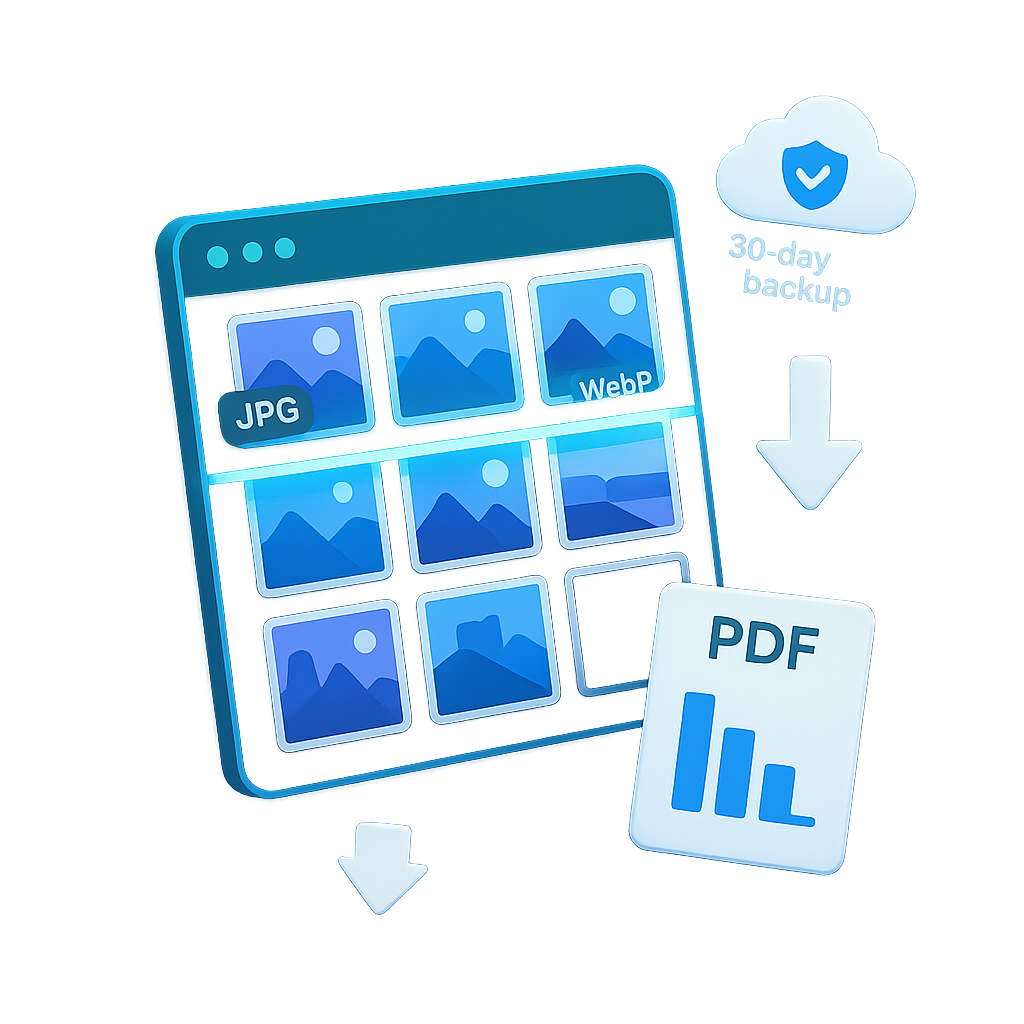
Service Overview
Faster page loads, lower hosting costs, and better SEO - through a complete one-time optimisation of your existing image library.
Most websites quietly carry years of unoptimised images. Every product photo, blog banner, gallery shot, and team picture uploaded over time was added at full resolution, with no consistent compression standard. Over three to five years, that adds up to thousands of oversized files - each one slowing down page loads, eating into hosting storage, and dragging down search rankings.
Image Library Optimisation fixes this in a single, controlled batch pass. We process your entire existing media library - product catalogues, blog archives, portfolio galleries, every folder - and apply quality-preserving compression alongside WebP conversion. WebP is the modern format used by Google, Amazon, and most large publishers because it cuts file size by 25 to 80 percent compared to JPEG and PNG, with no visible difference in quality. Older browsers automatically fall back to your original format, so nothing breaks for any visitor.
Your original files are not touched. They are securely backed up before processing and kept for 30 days, so any image can be restored if you ever need it. Our engineers run the batch during a low-traffic window agreed with you, so live customers see zero disruption. For WordPress and WooCommerce sites, we also regenerate every responsive thumbnail size, so your theme keeps serving the right image to phones, tablets, and desktops - just lighter.
When the pass completes, you receive a clear before-and-after report showing exactly how much storage was reclaimed, how much page weight dropped on your key templates, and a sample of optimised images for visual quality verification. The result is a measurably faster website, lower bandwidth bills, stronger Core Web Vitals, and a better experience for the customers and search engines that matter most.
This service is built for any business sitting on years of accumulated media: eCommerce stores with thousands of product photos, photography portfolios, news and content publishers, real estate listings, hotel and hospitality sites, and any portfolio or catalogue site that has grown organically without a media cleanup.
Faster Page Loads
Lighter images mean every page loads faster, which improves engagement and conversions.
Lower Bandwidth Costs
Smaller files mean less data served - noticeable savings on metered hosting and CDN bills.
Better SEO & Core Web Vitals
Google rewards fast sites with higher rankings. Optimised images directly lift Lighthouse scores.
Originals Safely Preserved
Every source image is backed up for 30 days, so any file can be restored on request.
WebP With Smart Fallback
Modern browsers receive WebP. Older browsers automatically fall back, so no visitor is left out.
Mobile-First Performance
Smaller files load faster on mobile networks - a direct win for mobile traffic and rankings.
What's Included
Bulk WebP Conversion
Every qualifying image in your library is converted to the modern WebP format in a single controlled pass.

Quality-Preserving Compression
Source files are recompressed using lossless or near-lossless settings, so visual quality stays intact while file weight drops sharply.
Original File Backup
Every source image is securely backed up before processing and retained for 30 days, so any file can be restored on request.
Responsive Thumbnail Regeneration
For WordPress and WooCommerce sites, every registered thumbnail size is regenerated, so responsive images and lazy-loading keep working perfectly.
Before-and-After Savings Report
A detailed handover report showing exactly how much storage you reclaimed, how much page weight dropped, and sample visual quality comparisons.
Zero Workflow Disruption
We run the batch during a low-traffic window agreed with you in advance, so visitors and your daily content workflow see no impact.
Full Image Library Optimisation Checklist
How It Works
Place Your Order & Share Access
Once you complete checkout, you'll receive an order confirmation within 15 minutes. We'll then send a secure intake form where you share admin access to your website and any folders you'd like us to skip.
Library Audit & Scoping
Our engineer audits your full media library, confirms file counts, formats, and edge cases, and agrees a low-traffic batch window with you in writing. No surprises, no disruption.
Original File Backup
Before any compression starts, every source image is securely backed up. The backup is retained for 30 days, giving you a full rollback safety net throughout that window.
Batch Optimisation & WebP Conversion
During the agreed window, we run the bulk compression and WebP conversion across your entire library. Responsive thumbnails are regenerated, and image references are verified to keep your pages intact.
Sample Quality Review
We share a representative sample of optimised images for visual verification, so you can confirm the quality before final handover.
Final Report & Handover
You receive a clear before-and-after report with total storage saved, page weight reduction by template, and Core Web Vitals impact. Originals stay backed up for 30 days for any rollback request.
No. We use lossless or near-lossless settings, which means file size drops sharply but visual quality stays intact. We share a sample of optimised images for your verification before finalising the run, so you can confirm the result with your own eyes.
Typical turnaround is 3 to 7 business days from the moment you share access, scaled by the size of your media library. Smaller libraries (under 5,000 images) usually complete in 2 to 3 days; larger eCommerce catalogues take longer. We agree the exact batch window with you in advance.
No. We schedule the batch execution during a low-traffic window agreed with you. Visitors continue to see the website normally throughout the process. There is no downtime and no impact on your daily content workflow.
Every original image is securely backed up before any compression starts. Backups are retained for 30 days from project handover. If you ever want a specific image restored within that window, just let us know - there's no extra charge.
We support WordPress, WooCommerce, Magento, Shopify, and standard PHP-based custom websites. For other or proprietary platforms, we run a quick scoping call to confirm feasibility and provide a custom quote.
Plugins help with new uploads going forward, but they rarely clean up the years of unoptimised images already sitting in your library. This service handles the historical cleanup in a single controlled pass - work that plugins are not built to do reliably at scale.
Image weight is one of the largest contributors to Largest Contentful Paint (LCP) - a key Core Web Vitals metric. On image-heavy sites, customers typically see PageSpeed score improvements of 10 to 30 points and noticeable LCP reductions on product, gallery, and content pages.
New uploads after the batch run are not covered by this one-time service. For ongoing optimisation, you'll either want a recurring website maintenance plan or a WebP delivery configuration on your CMS - we're happy to advise on the best option for your stack.
Yes. WooCommerce catalog images, single-product images, gallery shots, and variation thumbnails are all included. We also regenerate WooCommerce-specific thumbnail sizes so the storefront keeps rendering correctly.
Refunds apply if work has not yet started. Once batch processing begins the service is considered rendered. That said, we share a sample for visual verification before completing the run, so you can confirm quality at the right point - and we'll always work with you on any specific concerns.
1. This service is a one-time engagement. Each purchase covers a single batch optimisation pass on one website. A fresh purchase is required for every future run.
2. You provide administrative access to the website and its media storage. Access credentials must remain active throughout the agreed work window.
3. Original image files are securely backed up before processing. The backup is retained for 30 days from project handover, allowing rollback within that window. After 30 days, backups are purged.
4. Refunds apply only if work has not yet started. Once batch processing begins, the service is considered rendered and no refund is issued.
5. Images uploaded after the batch pass are not covered by this purchase. Ongoing optimisation of new uploads requires a recurring maintenance plan or a WebP delivery configuration on your website.
6. We are not responsible for visible quality loss where source files were already heavily compressed, corrupted, or served through a third-party network that transforms images before delivery.
7. Supported platforms include WordPress, WooCommerce, Magento, Shopify, and standard PHP-based websites. Other platforms may require a scoping call and a custom quote.
8. Work is executed on your website infrastructure. Any temporary working copy used during processing is securely discarded once the batch run complete
Related Services
You might also be interested in these services.
Marketing teams get a professionally designed new page, built on-brand and without touching monthly edit hours. Bille...
WordPress and WooCommerce site owners get a fully configured blog section ready to publish on day one. Categories, ta...
Professional CDN setup that makes your website load faster for visitors anywhere in the world.
WordPress site owners on an aging theme get a safe migration to a new or upgraded theme without losing settings or br...
WooCommerce stores get live shipping rates at checkout and automated label generation through direct integration with...
A one-time speed pass that fixes the layers actually moving PageSpeed scores - without locking you into a monthly ret...